
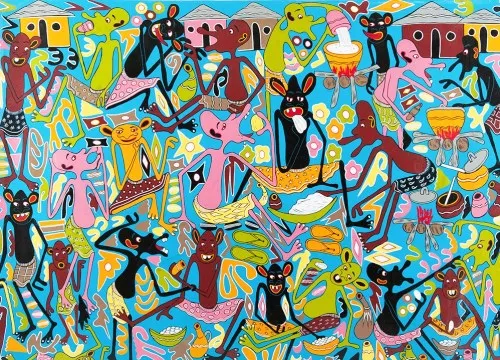
A Master of Myth and Playful Satire
George Lilanga (1934–2005) stands among the most famous and internationally celebrated visual artists to emerge from East Africa. Born in Kikwetu, southern Tanzania, of Makonde heritage, Lilanga bridged traditional African cosmology with modern global contemporary art, developing a visual language that remains instantly recognizable worldwide.
Before settling in Dar es Salaam and frequently exhibiting across East Africa, Lilanga honed his craftsmanship as a traditional woodcarver, sculpting soft soft-wood Shetani (spirit) figures in traditional Makonde style. Transitioning to canvas, hardboard, and enamel paint, he transformed these traditional spirits into colorful, modern urban inhabitants.
The Gallery Watatu Connection & Global Explosion
During the 1980s and 1990s, Lilanga’s association with Nairobi’s Gallery Watatu propelled his career onto the world stage. Gallery director Ruth Schaffner heavily promoted Lilanga’s paintings and relief sculptures, introducing international collectors to his humorous, crowded, and socially observant compositions.
Lilanga’s paintings depict mischievous Shetani spirits engaging in everyday human activities—dancing, drinking, arguing, listening to radio broadcasts, and driving cars. Through these colorful creatures, Lilanga presented sharp yet playful commentary on human nature, urban greed, community life, and modern social dynamics.
Pop Art Comparisons and World Heritage
Lilanga’s striking line work, bright flat colors, and dynamic figure placement frequently earned him comparisons to American pop artist Keith Haring, though Lilanga’s iconography was deeply rooted in Makonde oral traditions.
His works have been showcased in major international institutions and landmark exhibitions globally, including:
-
Africa Hoy (Groningen Museum, Netherlands).
-
Contemporary African Art Collection (CAAC) (Jean Pigozzi Collection).
-
Permanent collections at the Musée des Beaux-Arts (Nantes, France) and the Houston Museum of Fine Arts (USA).
George Lilanga’s legacy endures as a vital bridge between East African heritage and global contemporary art.